
Introduction
Software development has changed a lot in the last decade. Today’s businesses need applications that can be built faster, maintained more easily and adapted to changing customer needs. Developers now have two primary ways to meet these expectations:
- Introduction
- What is Low-Code Development?
- What is Traditional Coding?
- Real-World Example 1: Building an Employee Leave Portal
- Development Low-code
- Traditional Coding
- Real-World Example 2: Amazon
- Real-World Example 3: Internal HR Dashboard
- Where Low-Code Wins
- 1.Rapid Development
- 2.Lower Costs
- 3.Citizen Developers
- 4.Easier Maintenance
- 1. Unlimited Customization
- 2.Better Performance
- 3.Better Security
- 4.Large Scale Applications
- AI is Changing Both Worlds
- Challenges of Low-Code
- Challenges of Traditional Coding
- Which Should You Learn in 2026?
- The Future: Hybrid Development
- Final Verdict
- Frequently Asked Questions (FAQs)
- Does low-code take over programmers’ jobs?
- Can enterprises make their applications using low-code?
- Which is good for starters?
- Should I learn both?
- Low-Code Development
- Traditional Coding
With the rise of AI, automation and cloud computing, low-code platforms are becoming super powerful. But the backbone of enterprise software, operating systems, games and high performance applications is traditional coding.
So what makes more sense in 2026?
The answer isn’t as simple as picking one or the other. Each has its pros and cons and best use cases.
In this guide we’ll compare low-code and traditional coding in detail, look at real-world examples, write actual code and help you decide which approach really takes the cake in 2026.
What is Low-Code Development?
Low-code development is a visual way of building software using drag and drop interfaces, reusable components, workflows and minimal hand-written code.
Developers configure application logic visually, instead of writing thousands of lines of code.
Low-code platforms that are popular include:
- Microsoft Power Apps
- OutSystems
- Mendix
- Appian
- Bubble
- Zoho Creator
- Retool
Imagine not having to write backend APIs to create a customer registration portal. Just drag a form on the screen, connect it to the database and you are done!
Such is the power of low code.
What is Traditional Coding?
Traditionally, coding is the process of creating applications from scratch in programming languages and frameworks.
Each feature is written by hand by the developers .
They use languages like :
- JavaScript
- TypeScript
- Python
- Java
- PHP
- C#
- Go
- Rust
Some of the more popular frameworks are:
- React
- Angular
- Vue
- Laravel
- Django
- Express.js
- Spring Boot
- ASP.NET Core
In traditional coding, you have complete control over architecture, security, performance and scalability.
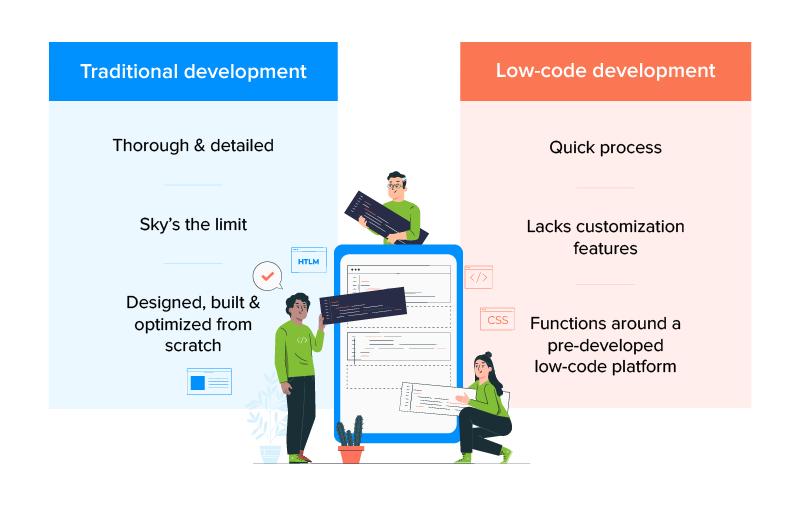
A Quick Comparison
| Feature | Low-Code | Traditional Coding |
|---|---|---|
| Development Speed | ⭐⭐⭐⭐⭐ | ⭐⭐⭐ |
| Flexibility | ⭐⭐ | ⭐⭐⭐⭐⭐ |
| Scalability | ⭐⭐⭐ | ⭐⭐⭐⭐⭐ |
| Customization | Limited | Unlimited |
| Learning Curve | Easy | Steep |
| Maintenance | Easier | Developer Required |
| Enterprise Projects | Moderate | Excellent |
| Cost | Lower Initially | Higher Initially |
| Performance | Good | Excellent |
| AI Integration | Growing | Full Control |
Real-World Example 1: Building an Employee Leave Portal
Let’s say a company needs an employee leave management system.
Development Low-code
A developer of Microsoft Power Apps can:
- Drag Leave Request Form
- Link to Microsoft Dataverse
- Add Approval Workflow
- Send messages in Teams
- Release the app
Time to Develop:
1-2 Days
No backend development needed.
Traditional Coding
A developer would construct:
Frontend
- React
Backend
- Node.js
Database
- PostgreSQL
Authentication
- JWT
Email Service
- SMTP
Deployment
- Docker + Cloud
Development Time:
2-3 weeks
Real-World Example 2: Amazon
Every hour, Amazon processes millions of orders.
Would Amazon use a low-code platform?
Not possible.
Rationale:
- Millions of simultaneous users
- Recommendation system
- Payment Handling
- Microservices in a distributed setting
- Strong Search
- Warehouse automation
Amazon is too dependent on traditional coding because it needs full architectural control.
Real-World Example 3: Internal HR Dashboard
Let’s say an HR department wants:
- Personnel records
- Granting leave
- Reports of attendance
- Salary dashboard
A low-code platform allows you to build it in days instead of months of manual development.
This is exactly where low-code excels.
Traditional Coding Example
Let’s create a simple REST API using Node.js.
const express = require("express");

const app = express();

app.get("/users", (req, res) => {
    res.json([
        {
            id:1,
            name:"John"
        },
        {
            id:2,
            name:"Alice"
        }
    ]);
});

app.listen(3000, () => {
    console.log("Server running...");
});
Output
[
   {
      "id":1,
      "name":"John"
   },
   {
      "id":2,
      "name":"Alice"
   }
]
Everything here is written manually.
You have full control over every request, middleware, authentication layer, and database connection.
Another Example: React Login Component
import { useState } from "react";

function Login(){

const [email,setEmail]=useState("");

return(

<div>

<input
type="email"
placeholder="Enter Email"
onChange={(e)=>setEmail(e.target.value)}
/>

<button>Login</button>

</div>

);

}

export default Login;
A low-code platform could generate something similar visually, but traditional coding gives you unlimited flexibility.
Where Low-Code Wins
1.Rapid Development
Businesses always have to develop applications rapidly.
With low code, organizations can have their product launched within days rather than months.
This cuts down the development process time considerably.
2.Lower Costs
Developing a stack development team can be expensive with several thousands of dollars per month.
Low code minimizes:
- Developer time
- Maintenance costs
- Cost of infrastructure
These savings are of particular importance to small businesses.
3.Citizen Developers
The most prominent trend of 2026 is that of citizen developers.
They are people who work in non-technical jobs like human resources, finance, operations, or marketing but are capable of developing apps through visual interfaces despite not having programming expertise.
4.Easier Maintenance
It is just as easy to update a form or workflow by simply adding a new component or changing a configuration setting.

Where Traditional Coding Wins
1. Unlimited Customization
- Recommendation engine with AI for your project?
- Blockchain integration required?
- Advanced payment processing required?
Traditional coding allows you to do this.
2.Better Performance
The hand-optimized code is always going to be faster than the generated code.
A lot can be gained from this approach on large-scale systems.
3.Better Security
Industries such as:
- Banking
- Healthcare
- Defense
depend on traditional coding since programmers have complete control of the security layers.
4.Large Scale Applications
Examples include:
- Netflix
- Uber
- Meta
- Spotify
These corporations use traditional coding since they need huge scalability and customized infrastructure.
AI is Changing Both Worlds
In 2026, AI has proven itself an incredibly valuable ally for programmers no matter what methodology they prefer.
With AI, we can now:
- Code without programming
- Fix bugs
- Layout user interface
- Produce SQL code
- Write documentation for APIs
- Develop unit tests
- Improve performance
Low-code environments are starting to incorporate AI assistants that generate workflows from natural-language prompts.
Traditional programmers work with AI-assisted coding tools in order to accelerate their work without giving up control over application architecture.
And that’s how the future is not about AI replacing developers but about AI assisting developers in building applications.
Challenges of Low-Code
However, despite all the advantages that low-code offers, there are some drawbacks to it as well.
They are as follows:
- Vendor lock-in
- Expensive licensing
- Inability to customize
- Restrictions on performance
- Challenge of application migration
- Less control over the code generated
The complexity of applications makes these restrictions even more obvious.
Challenges of Traditional Coding
Traditional development too has some disadvantages.
These include:
- Extended development time
- Increased cost
- Higher learning curve
- Increased testing and debugging efforts
- Larger development team
- Maintenance issues
Opting for traditional coding is more time-consuming but it does pay off in the long run.
Which Should You Learn in 2026?
It all depends on what your career aspirations are.
Pick Low-Code if you:
- Wish to develop business apps fast
- Have an operations, HR, or finance background
- Need quick prototypes
- Favor visual coding
Pick Traditional Coding if you:
- Are aspiring to be a software engineer
- Like problem-solving
- Intend to develop scalable web applications
- Are going to work in the fields of AI, cloud computing, gaming, or cyber security
For most professionals, combining both makes sense.
The Future: Hybrid Development
Hybrid development is one of the main 2026 trends.
Organizations are now blending low-code platforms with custom coding.
For instance:
- Low-code platform for creating customer portals
- Node.js backend API
- Python AI service
- Custom microservice for authentication
- Deployment on cloud via Docker and Kubernetes
Thus, hybrid development provides the agility of low-code platforms with all the benefits of conventional software development.
Final Verdict
There is no definite victor in the fight between low-code and regular coding.
When speed, prototyping, and internal business application are what you want, then low-code is the way to go.
When full control, scalability, security, and good performance are required, regular coding still takes the lead.
Developers who will be successful in 2026 won’t stick to just one option. They will know when to use low-code and when to code by hand.
They will be successful in combining both coding styles.
Frequently Asked Questions (FAQs)
Does low-code take over programmers’ jobs?
No, low-code simplifies the development process by reducing redundant coding work but developers are required for architecture, integration, security, and complicated business logic.
Can enterprises make their applications using low-code?
Yes, there are many enterprise-level internal tools, dashboards, and workflows which can be made using low-code. But highly customized and performance-sensitive applications use traditional code.
Which is good for starters?
Low-code is easy for beginners to learn due to the focus on visual development whereas traditional coding is time-consuming but offers deep knowledge about software engineering.
Should I learn both?
Yes, definitely, learning both will help you pick up whatever is best suited to the project and makes you very much sought after in today’s world.